
Reading Time: minutes
Recent geopolitical tensions in the Middle East are once again pushing global energy markets upward, with early local estimates indicating significant increases in gasoline, diesel, and kerosene prices. For industries that rely heavily on transportation—manufacturing, retail distribution, construction, and e-commerce—fuel inflation quickly translates into higher operating costs across the supply chain.
In the Philippines, where goods movement depends largely on road transport, fuel price volatility can have an outsized impact on logistics expenses. Diesel alone represents a major cost component for trucking fleets, and sustained increases can rapidly erode margins for businesses operating large distribution networks.
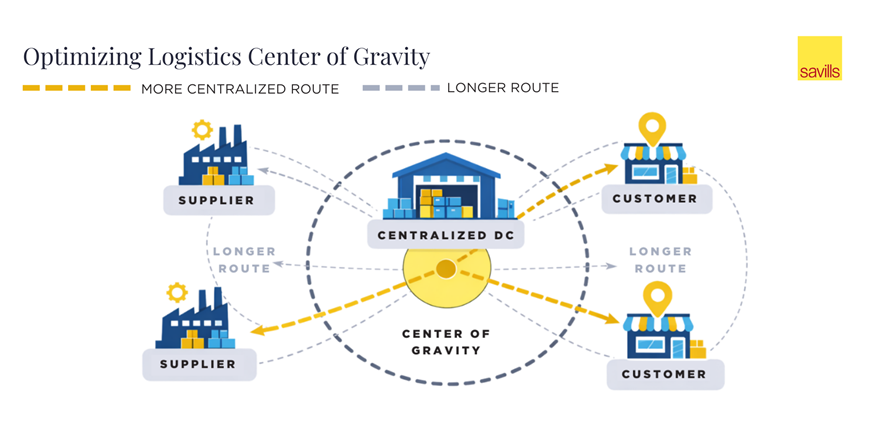
This environment is prompting many companies to reassess how their supply chains are structured. One increasingly important strategy is the optimization of distribution center (DC) locations based on a company’s logistics center of gravity—the geographic point that minimizes overall transportation costs between suppliers, warehouses, and customers.
By positioning centralized distribution facilities closer to this center of gravity, companies can significantly reduce total kilometers traveled across their delivery networks. Fewer route miles translate directly into lower fuel consumption, improved delivery efficiency, and greater resilience against energy price volatility.
For logistics-intensive sectors, this shift is also reinforcing demand for strategically located industrial and warehouse assets, particularly those with strong access to major expressways, ports, and emerging infrastructure corridors. Industrial locations that allow companies to consolidate inventory and shorten delivery routes are becoming increasingly valuable as firms prioritize cost efficiency and operational resilience.
Looking ahead, rising fuel costs may accelerate a broader evolution in supply chain planning across the Philippines. Businesses are likely to place greater emphasis on data-driven logistics planning, network consolidation, and infrastructure-aligned warehouse locations.
In a period of energy uncertainty, companies that rethink their distribution strategies today—anchoring their logistics networks around optimized, centralized hubs—will be better positioned to control costs and maintain competitiveness in the years ahead.

Related Services:
Written by

- fuel
- inflation
- logistic
- imperative
- oil
- savills
- savillsph
- savills philippines
- fuel inflation
- new logistics imperative
- philippines news
- philippines article